⬇️ Prefer to listen instead? ⬇️

- 🌍 Over 20,000 lichen species have been identified worldwide, with more discovered yearly.
- 🚀 Some lichens can endure space-like conditions, surviving intense radiation and vacuum.
- 🔬 Lichens act as bioindicators for air pollution due to their extreme sensitivity to environmental toxins.
- 🔄 A lichen’s fungal component must find the right photosynthetic partner to reproduce sexually.
- 🧬 Lichens challenge species classification by functioning as multi-organism holobionts.

Introduction
Many people used to think lichens were mosses or tiny plants. But lichens are a remarkable type of life that doesn’t fit neatly into any simple group. They may look like small crusts clinging to rocks or trees, but they’re actually two organisms living together: a fungus and a photosynthetic partner such as algae or cyanobacteria. This special partnership makes them incredibly tough. They can survive in some of Earth’s harshest environments— and even in space. Whether you study fungi in the wild or grow related species at home in Mushroom Grow Bags or a Monotub, understanding lichens helps reveal just how adaptable and surprising fungal relationships can be. Let's explore why scientists, mushroom experts, and nature lovers are so fascinated by them.

What is a Lichen? The Symbiotic Organism Defined
Lichens are not just one organism. Instead, they are complex systems of different organisms living together. They mostly have two main parts:
- Mycobiont: This is the fungus. It usually comes from the Ascomycota group. The fungus gives the lichen its shape, holds water, and protects it from harsh weather.
- Photobiont: This is a partner that makes its own food. It is either a green alga (algal symbiont) or a cyanobacterium. It creates energy-rich sugars through photosynthesis.
Some lichens have both green algae and cyanobacteria. This gives them two benefits. The algae make sugars, and the cyanobacteria fix nitrogen. This partnership turns lichens into “super organisms.” They can grow in some of Earth's toughest places.
New discoveries also show there are more bacterial partners. This adds even more complexity. These third partners often help control things or move nutrients around. This shows lichens are not just two partners working together. They are full small ecosystems.
Lichens show how strong mutualism can be. This is a way different species share jobs to survive together. They have changed over millions of years. This happened not only through natural selection, but also by finding a steady balance in working with each other.

Why Lichens Are Not Plants
Lichens can look leafy and green. But that's where their likeness to plants stops.
Here’s why lichens are very different from plants:
- No roots or tubes: Plants have roots, stems, or tubes like xylem and phloem to move water and food. Lichens do not. Instead, lichens get all their water and nutrients from the air around them.
- Get food from air: Lichens take in almost everything directly from the air, including pollution. This makes them great at showing us about the environment.
- Mostly fungus: The main organism in a lichen is a fungus. The fungus controls the lichen's genes and its overall shape.
- Grow slowly: Some lichens grow only 0.1 mm each year. This extreme slowness is the opposite of how most plants grow. It makes lichens survivors that live a very long time.
- Different life group: The part that makes food might come from the green algae group, which is close to plants. But the main fungal half clearly puts lichens in the fungus group.
In short, lichens are not like plants. Their systems are all about the fungus, which connects with partners that simply give energy.

Anatomy Beyond Simplicity: Inside a Lichen
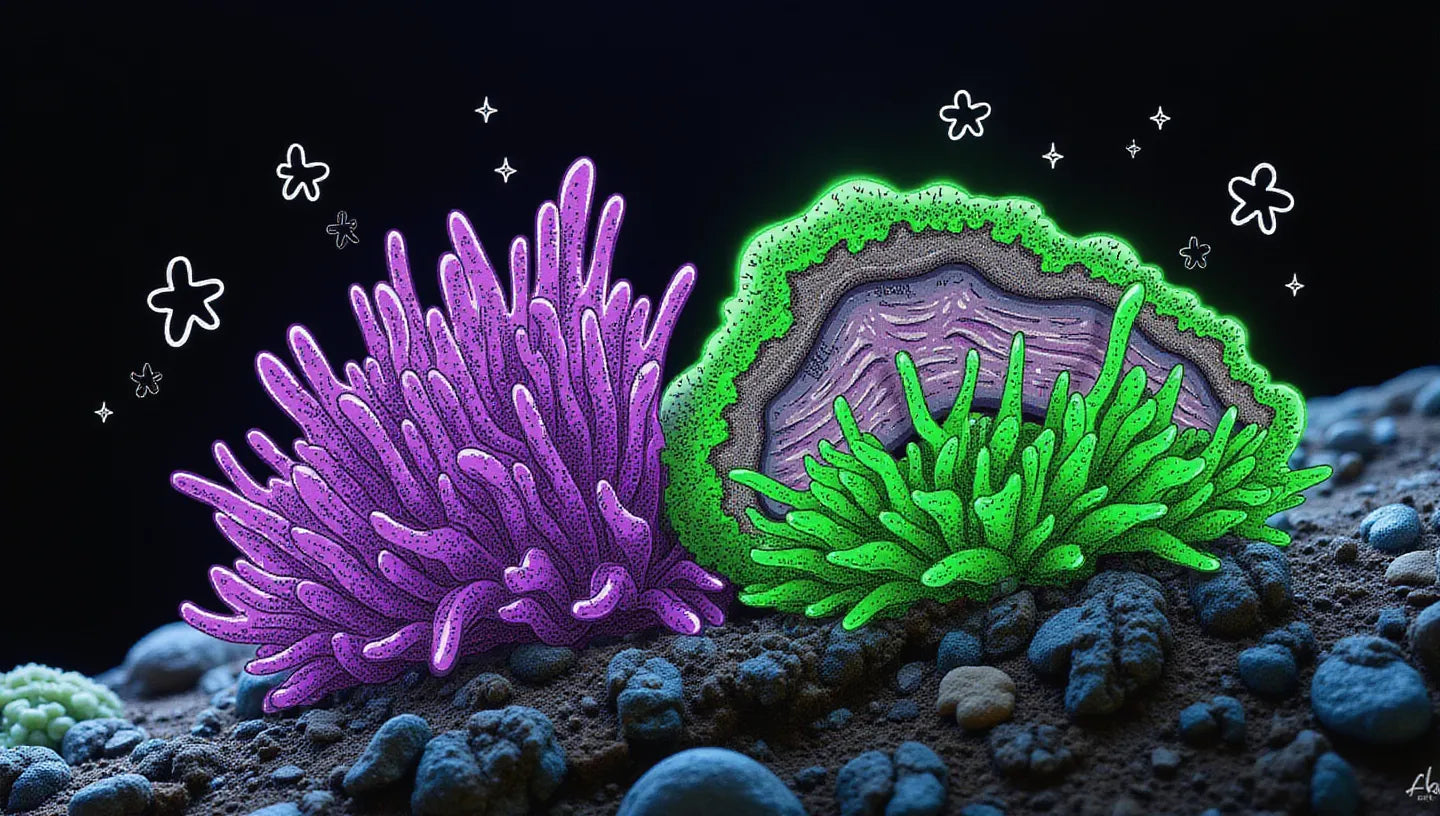
A simple crusty patch is actually a biological wonder with many layers. The lichen's thallus (its outside body) has a very well-made structure. This structure helps it live well under stress.
Layers of a typical lichen thallus:
- Upper cortex: This is the hard skin made of tightly packed fungal threads (hyphae). It works like a protective shell. It guards against drying out, UV light, and tiny living threats.
- Photobiont layer: Right under the cortex is a layer full of algal or cyanobacterial cells. This layer is in charge of making most of the energy through photosynthesis.
- Medulla: The middle layer has loosely woven fungal threads (hyphae). These threads help with air flow and keeping moisture steady.
- Lower cortex (in some types): This bottom layer might have anchoring parts called rhizines. Lichens use these to attach to things like bark, rock, or dirt.
Growth Forms of Lichens
Lichens grow in three main shapes:
- Crustose: These grow tightly stuck to surfaces. They make flat, crust-like patches. Pulling them off often harms the surface below.
- Foliose: These are loosely attached and look like leaves. They have clear top and bottom sides. They often hang down or spread out, which makes them easier to pick for study.
- Fruticose: These stand up, are bushy, or look like hair. They sometimes look like coral or small bushes. Their 3D shape lets them get the most light and air.
Also, lichens often have colored chemicals. These are things like usnic acid, parietin, and atranorin. These chemicals fight germs or help protect against UV rays. They give many lichen types their bright colors.

How Lichens Work: Physiology and Survival Strategies
Lichens are great at staying alive with minimal needs and by adapting. This lets them live in places where few other organisms can.
Photosynthesis & Getting Nutrients
The photobiont inside a lichen carries out photosynthesis. It turns sunlight, water, and carbon dioxide from the air into sugars. These nutrients then spread through the fungal network.
At the same time, the fungus takes in water and minerals directly from the air. This process is known as poikilohydry. It does not pull them from the soil like plants do.
Drying Out and Cryptobiosis
Lichens are incredibly tolerant of drying. Many enter a state called cryptobiosis. In this state:
- Their body processes stop,
- Proteins that can handle drying keep cell parts stable, and
- The organism goes into a sleeping state until it gets wet again.
This strategy allows lichens to survive in some of Earth’s toughest places. This includes Antarctic rocks and very hot deserts.
Temperature and Light Tolerance
Lichens can handle:
- Big seasonal temperature changes
- Dark Arctic winters
- Sun's radiation near the equator or in space
Their colors and layered structure act as physical shields. Also, internal antioxidants reduce harm to living cells from stress.

Reproduction and Dispersal: Complexities of Multipartnered Reproduction
Lichen reproduction, much like their structure, is not simple. This is because they have two (or three) parts.
Asexual Reproduction
Asexual methods are the best way lichens spread themselves as whole partnerships. The lichen may release:
- Soredia: These are tiny balls made of both photobiont cells and fungal threads (hyphae).
- Isidia: These are finger-like growths on the surface of the thallus. They break off to start new lichens in other places.
Both of these let new lichens grow quickly without needing to find a photobiont again.
Sexual Reproduction
Sexual reproduction happens only through the fungal partner. It involves:
- Making reproductive parts like apothecia or perithecia. These parts produce fungal spores.
- These spores travel by wind or water.
- To create new lichens, the spores must find and join with a good photobiont that is already living in the area.
This need for a partner makes it quite risky. Sexual reproduction is more a way to get genetic variety than a reliable way to spread.
Partner Switching
Some lichens can switch partners, especially when they are under stress. If a favored photobiont is not there, or does not work as well due to changes in the environment, some fungi can take on a new, matching alga or cyanobacterium. This shows how flexible they can be.

Species Concepts: Why Lichens Break Taxonomy Rules
The usual ways to define species do not work well for lichens. Since lichens are based on partnerships, this brings up questions:
- Is a lichen one species, or a mix of many?
- Should we name it after the fungus (as we usually do), or should we show both partners?
Discussions in taxonomy have led to the idea of holobionts. These are groups of many species that work together as units that change over time. Think about how corals need symbiotic algae, or humans need gut bacteria. Lichens change how scientists define what makes an individual and what identity means in biology.
This view shows a bigger shift. It means accepting symbiosis as a cause of change over time, not just something that developed later.

Diversity of Lichen Species and Forms
People guess there are between 18,000 and 20,000 lichen species recorded right now. But many think the true number is over 30,000. This is especially true in places often missed, like tropical forest tops and very harsh environments (Nash, 2008).
Differences in Photobiont Type
Some lichens use:
- Green algae (e.g., Trebouxia): This is the most common type.
- Cyanobacteria (e.g., Nostoc): These often work with nitrogen fixation.
- Two photobionts: A small number use more than one partner that makes food. This can make them tougher in different environments.
Where Lichens Live
Lichens live in:
- Arctic tundra and hot deserts
- Mountaintops and deep valleys
- City walls, rooftops, and even gravestones
- Tree bark, soil, or leafy forest floor areas
Every kind of place offers a home to some specialized lichen species.

Ecological Superpowers of Lichens
Lichens may be small, but they have a lot of power in nature:
- First to grow: They are one of the few life forms that can grow straight on bare rock. They help slowly make soil over hundreds of years.
- Nitrogen fixation: Lichens with cyanobacteria add nutrients to poor environments. This is especially important in new natural areas.
- Pollution checkers: Lichens get nutrients and water from the air. So, they easily soak up toxins like sulfur dioxide or heavy metals. This makes them very important for checking air quality (Hawksworth & Rose, 1970).
- Help shape nature: They make small homes for insects, trap moisture for young plants, and provide nesting stuff for birds.
Some types are so sensitive that if they disappear, it can be a warning sign that nature is in trouble.

Lichens and Human Use: Ancient Dyes to Modern Science
For a long time, people have used the hidden qualities of lichens.
Old Uses
- Natural Dyes: Lichens have given colors like purple (orchil), red, and yellow. People have used these in cloth and ink for hundreds of years.
- pH Checkers: Litmus, a well-known chemical for testing pH, comes from lichen parts.
- Medicine: Icelandic moss (Cetraria islandica) has been used for coughs and wounds in Nordic medicine for generations.
New Ideas
- Perfumes: Oakmoss (Evernia prunastri) adds a special smell to expensive perfumes.
- Medicines: Lichens are places where we get special chemicals. These are being tested for properties that fight germs, fungi, cell damage, and even tumors.
- Checking the Environment: The different types of lichens and their health are important parts of how we measure life's variety and efforts to protect it.

Lichens in Extreme Environments – Space, Ice, and Deserts
Lichens do not just survive; they do very well in places where few other living things can:
- Antarctica: Lichens grow right on Antarctic rocks. They get only a few hours of sun in a year to make food.
- Deserts: They can soak up dew or mist. They stay inactive for months during dry spells.
- Space simulators: Types like Hypogymnia physodes and Lecanora helicopis lived through zero-pressure, UV-radiation conditions in Mars test rooms (De Vera et al., 2010).
Their toughness makes lichens important living things in astrobiology. They show how life might be possible on other planets.

The Fungal Perspective: Why Mycologists Care About Lichens
For a mycologist (a mushroom expert), lichens are more than just interesting things. They are key to understanding fungi.
- Cooperation experts: Lichens let us study, in real time, how different life groups work together.
- Mostly Ascomycetes: Most fungi that form lichens are part of the Ascomycota group. This gives a clear group to study for how they change over time and for molecular tests.
- Clues to change: Lichen formation has happened many times on its own. This gives clues about how different things change to become similar.
- New ways of life: Lichens show how fungi connect closely with other types of life. This could offer examples for new ideas in biotech.

Conservation and Environmental Impact
Even though lichens are tough, they face real dangers:
- City growth and cutting down forests destroy old lichen homes.
- Air pollution like sulfur dioxide and ozone harms their sensitive bodies.
- Weather changes how things grow faster than lichens can get used to them.
Efforts to protect nature now focus on saving old forests, rocky places, and some rare lichen types. Many of these rare lichens are signs of bigger changes in nature.

For the Mushroom Lover: What Can You Learn from Lichens?
If you love mushrooms and fungal life, lichens can make you appreciate them more in ways you might not expect.
They show:
- How different life groups work together in real time
- That fungi can power complex natural systems
- New ways to grow things, protect nature, and even use them personally (for dyes, smells, medicines)
For people who grow things, gather food, and citizen scientists, studying lichens lets you see up close how they quietly work together to survive.
Final Thoughts: More Than Meets the Eye
Lichens are where new fungal ideas, how well they handle nature, and how complex their changes over time are, all meet. They are not just simple mossy crusts. Instead, they are very well-made partnerships between different life groups. When we understand lichens, we also understand toughness, cooperation, and biological creativity. The next time you see a splash of green or orange on a stone, think: you are seeing one of life’s most amazing partnerships.
References
-
De Vera, J. P., et al. (2010). Survival potential of Hypogymnia physodes and Lecanora helicopis in Mars simulation chambers. Astrobiology, 10(3), 215–227.
-
Hawksworth, D. L., & Rose, F. (1970). Qualitative scale for estimating sulfur dioxide air pollution in England and Wales using epiphytic lichens. Nature, 227(5258), 145–148.
-
Nash, T. H. (2008). Lichen Biology. Cambridge University Press.